
After the birth of her daughter, Ashley Adams felt something wasn’t right. Her baby, Maddie, was healthy — it was herself she was concerned about.
She sensed that her irritability, fatigue and tendency to cry more than usual were signs of more than the “baby blues” — a perinatal mood and anxiety disorder that usually resolves naturally within three weeks of giving birth, signaling a normal hormonal adjustment period for new mothers.1
Ashley’s intuition, her internalized experiences and education, told her that things were not “normal.”
Signs and symptoms
Ashley was no stranger to anxiety. Being a healthcare and human services professional, serving as a board member of Mindspring Mental Health Alliance and having family members and friends with histories of mental health diagnoses, Ashley had the “head knowledge” to understand the symptoms. She also had personal experience, being diagnosed in 2018.
“I’ve always had some anxiety … related to specifically some negative internal thoughts, and … negative ruminating thoughts,” Ashley says. “We were growing our rehabilitation department [at Optimae LifeServices] and my stress was increasing [with] more responsibility, more stress, and it was really having a negative impact on my anxiety. [My direct supervisor], the wonderful Sheri Gill, actually recommended mental health therapy to me … because I started responding negatively to certain things that didn’t need such a negative or defensive response.”
A deeper diagnosis
Eight years after that conversation, as Ashley sat in the OB-GYN office for her postpartum checkup, she completed a PHQ-9, the patient health questionnaire-9. Since Ashley administers the depression screen in her line of work, she knew what her scores meant. She thought, “This is postpartum depression.”2
“I said at the end of the visit, because I consider myself an advocate, ‘Could you tell me a little bit about postpartum depression?’” Ashley says. “I had to find it and bring it up myself, which is not how it should be.”
After her experience at the OB-GYN’s office, Ashley and her husband, Bill, brought their daughter in for a routine wellness check. Ashley and Maddie share a primary care provider, so Ashley and the PCP had an existing relationship.
“She looked at me during my daughter’s appointment and said, ‘Are you OK?’ — And meant it,” Ashley says. “You know, there’s a huge difference when you go see a provider and they ask you how you’re doing. And she meant it, and I lost it. And I said, ‘I’m not doing well. I am mentally not doing well.’”
In that moment of “losing it,” Ashley gained what, deep down, she was seeking. She gained an advocate. She gained understanding.
“I was really lucky that … I had that relationship with my primary care provider before,” Ashley says. “I started being honest. I started telling her about my feelings of worthlessness and how I felt like I was letting my husband down and that I wasn’t being a good mom and that … I wanted to go back to work. And then I had this huge feeling of dread, and how am I going to work and be a mom and do all these things?”
A partner’s perspective
As Ashley opened up and shared her concerns, her husband’s eyes were opened to what Ashley had been reluctant to reveal.
“My husband was also there, and his eyes went just like deer in headlights, because he had no idea that I was having those thoughts, because I tried to keep it to myself,” Ashley says. “I didn’t want it to be harder than it already was for anybody.”
Ashley had been keeping a strong front on the surface. But under the surface, she had been struggling.
“I can’t remember how many times a day I would tell myself, ‘Just keep it together. Just keep it together. Don’t cry,’” Ashley says. “Because there’s enough other stuff going on that I don’t want to be the problem. And so I hid it. I hid it from the people who are closest to me, which is what I always tell people not to do.”
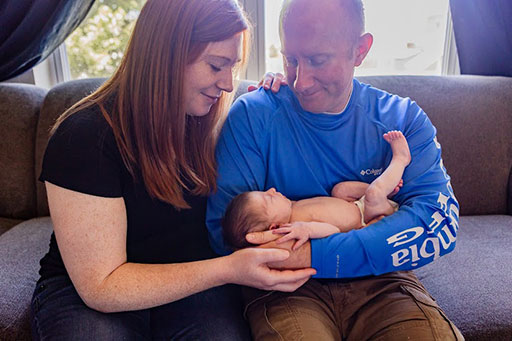
The experience of Ashley sharing her deepest fears allowed Bill to see how Ashley was feeling, and to think about how he was feeling, too.
“It’s important that we’re also checking in with the partner of the mom to make sure that they’re doing OK, too,” Ashley says.
Research bears that out. According to the Mayo Clinic, “fathers who are young, have a history of depression, experience relationship problems or are struggling financially are most at risk of postpartum depression. Postpartum depression in fathers — sometimes called paternal postpartum depression — can have the same negative effect on partner relationships and child development as postpartum depression in mothers can.”3
Telling truthful tales
So how can mothers and their partners receive the help they need? Ashley says the answer includes education, conversation and compassion.
“It’s important for me to share my personal story, about postpartum depression, because I even knew about postpartum depression, and it took a lot of effort and advocacy and my own awareness to actually get help for it,” Ashley says. “And, you know, I’m someone who’s blessed to have a lot of support in my life, and there’s a lot of people who don’t have that level of support. And [how] difficult it would be for them to even talk about it with someone, and I feel like we need to talk more about it.”
For Ashley, sitting with her PCP with her husband at her side was a tangible example of how talking leads to healing.
“It was just a great opportunity for him to see how I was feeling and to get support,” Ashley says. “And by the end of the visit, well, it had turned into my visit. [My PCP] was able to prescribe me an antidepressant. … I started taking that … it was really helpful.”
Following up with her therapist was also crucial to Ashley’s recovery.
“I was lucky that I had a mental health therapist already,” Ashley says. “I’ve been managing anxiety for before I knew what anxiety was, and I started mental health therapy in 2018. And so I had a long, long time therapist. … She really helped me through a lot of it, and she was able to help me recognize that this is beyond your hormones, this is beyond the baby blues. We need to take some next steps and get you taken care of.”
Learning loving life lessons
Today, nearing her daughter’s second birthday next month, Ashley says she’s learned a number of lessons.
“I … learned from this whole experience that I wish I would have started medication sooner to help manage my anxiety, because I’ve been feeling a lot better since I’ve started this medication, since I’ve had that postpartum depression experience,” Ashley says. “And I continue with therapy and I continue with my medication, and it’s just really helped me grow into a better person and a better mom.”
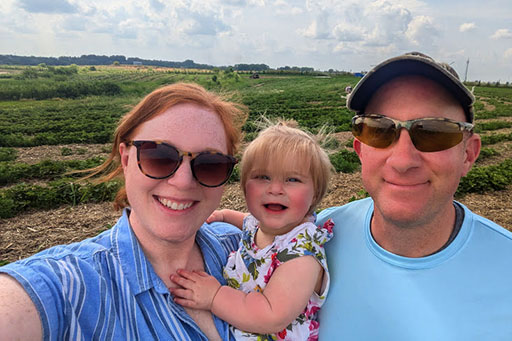
Ashley also credits her natural supports, like her husband.
“My husband, he’s the best — he is just so kind, and as a caregiver, kindness goes a long way,” Ashley says. “I’m sure there were instances where he was just overwhelmed and unsure of how to respond to when I was kind of having fluctuating moods and things like that. But he did so great at just asking questions or even just saying, ‘It’s OK. I’m here for you.’”
And, Ashley credits the small acts of kindness expressed by her friends.
“I had a friend who … just ran to Dunkin’ Donuts and got me a coffee, and she set it on the stoop of my porch and with a little sticky note that said, ‘You’re doing great,’” Ashley says. “And I still have the sticky note today. And I look at it every morning when I take my antidepressant. And I’m so thankful for just those small, little things that people can do.”
Ashley adds that large strides forward come from small acts of understanding. Like when her parents traveled three hours to visit her, a gesture that meant a lot to Ashley. They later made the return trek home when Ashley needed time alone. Though Ashley felt guilty for wanting to be alone versus spending time with the people who cared for her, the weight of “keeping it all together” was too great, and her family put her needs above their own.
“I was just like, ‘I need people to leave so I can go be by myself in my room, because I don’t feel well,” Ashley says. “Just those little things are really helpful.”
Looking back on her journey, Ashley has words of education and encouragement to offer.
First, to parents:
“It’s important to be able to check in with yourself and know how you’re feeling and how you’re acting,” Ashley says. “It’s important to pinpoint a natural support who can provide you that constructive feedback that maybe you’re just not yourself, even though you just had a baby. And it’s OK to not be yourself, but you might … not be OK.”
Second, to friends:
”Be a person, and say, ‘I’m going to ask you about your mental health, and I’m going to help you when I can and when you need it.’ You’ve got to make those pacts with your people.”
And third, to her past self:
“I wish I would have gotten mental health therapy sooner,” Ashley says. “It would have just made my life a lot easier sooner. … [Postpartum depression] just happens, and I experienced it, and I had to learn what it was before I could treat myself and understand it.”
Armed with that understanding, Ashley now knows the power of courageous communication.
“If you don’t feel like you’re yourself, you can always talk to someone about it,” Ashley says. “There’s always someone willing to have the conversation.”
If you believe you or your loved one may be experiencing postpartum depression, help is available. Visit postpartum.net or postpartumdepression.org, or call, text or chat 988 for the 988 Lifeline, which provides free, confidential care without judgement.
- Experts estimate about 80% of new parents experience mood swings and weepiness during the first 2-3 weeks after giving birth. https://postpartum.net/get-help-2/frequently-asked-questions
- Perinatal mood and anxiety disorders can appear during pregnancy or days or even months after childbirth, and does not usually resolve without treatment. While postpartum depression is sometimes used as a general term for these disorders, there is actually a spectrum of disorders that can affect mothers during pregnancy and postpartum. https://postpartum.net/wp-content/uploads/2014/11/PSI-PMD-FACT-SHEET.pdf
- New fathers may feel sad, tired, overwhelmed, anxious or have changes in their usual eating and sleeping patterns. These are the same symptoms that mothers with postpartum depression experience. https://www.mayoclinic.org/diseases-conditions/postpartum-depression/symptoms-causes/syc-20376617